If you have lifted an EV charging cable, its weight may seem surprising. The question “why are ev charging cables so heavy and thick” starts with electricity, not styling. Modern EVs can demand hundreds of amps during DC fast charging. That current needs low-resistance conductors, usually made from substantial copper or aluminum. A thin wire would heat faster and waste more energy. Heat matters.
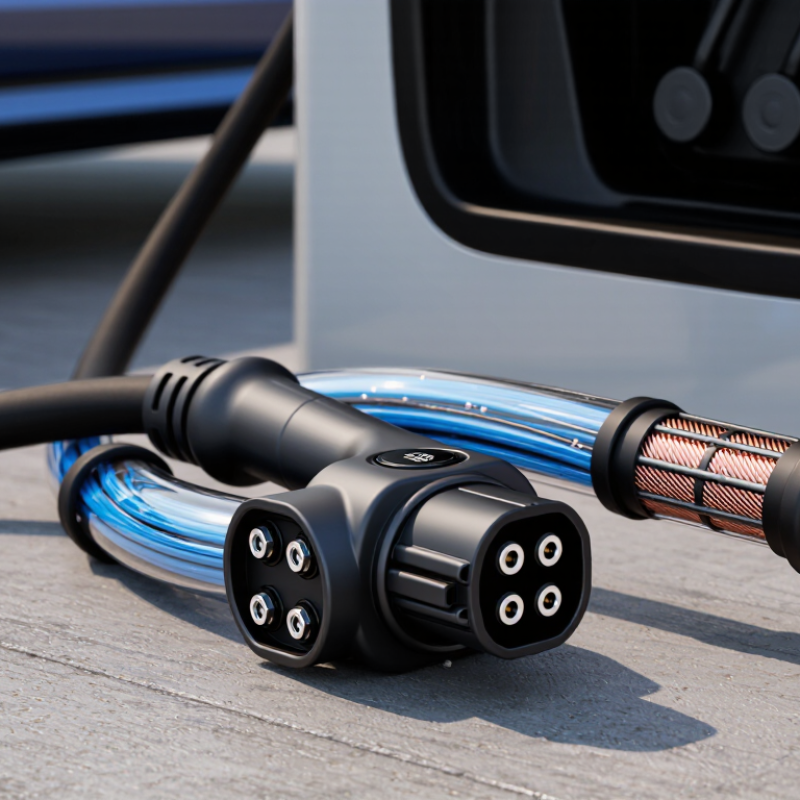
A charging cable also carries layers beyond metal. Thick insulation separates conductors and protects users from voltage, moisture, abrasion, and repeated bending. Many high-power cables include liquid-cooling channels, temperature sensors, shielding, and communication wires. The connector adds heavy contacts, seals, locking parts, and durable housing. In everyday use, the cable often feels heaviest near the plug. That balance helps it survive repeated handling, though it can strain the wrist. Cable length also increases material use and voltage drop.
Weight varies widely. An AC home cable may be lighter than a liquid-cooled fast-charging cable. Engineering teams select cable sizes using current ratings, heat limits, flexibility targets, and safety testing. These decisions follow technical requirements and manufacturer specifications, rather than appearance alone. Still, thicker does not always mean better. An oversized cable may be awkward, expensive, and unnecessary for a lower-powered vehicle. The practical answer depends on charging speed, distance, cooling design, and connector quality. Understanding these details makes the weight less mysterious. It also exposes a trade-off: more power usually demands more material, but better design can reduce the burden.
What an EV Charging Cable Must Deliver
Why Are EV Charging Cables So Heavy and Thick?
What an EV Charging Cable Must Deliver
An EV charging cable carries substantial electrical power for long periods. That demand creates heat inside the copper conductors. Thick conductors reduce electrical resistance and help control temperature. The outer jacket adds insulation, impact protection, and weather resistance. It also protects users from exposed electrical parts.
A dependable cable must deliver more than current. It needs stable communication between the vehicle and charging equipment. This connection controls charging limits and helps prevent unsafe conditions. A suitable cable also withstands repeated bending, twisting, rain, dust, and accidental pressure from tires. Field technicians often inspect the connector first. Discoloration, cracked seals, or unusual warmth can reveal hidden problems.
Weight alone is not proof of quality. A thick cable may contain strong insulation, but poor construction can still cause early failure. Conversely, a lighter cable may use efficient materials and remain safe within its rated limits. This is where technical standards, temperature ratings, and certified testing matter. Check the cable’s current capacity before connecting it to a vehicle. The charging setup must match the vehicle, outlet, and protective equipment.
There is no perfect cable.
A practical detail is often missed: storage affects service life. Tight coils create sharp bends and stress the internal conductors. I would prefer a slightly heavier cable with flexible handling, but that preference is not universal. Cold weather, limited storage space, and frequent public use can change the right choice. The best cable delivers power safely, communicates reliably, and survives its actual working environment.
Why Are EV Charging Cables So Heavy and Thick?
An EV charging cable must safely carry high electrical current while limiting heat, voltage drop, and mechanical wear. As charging power increases, the required current rises sharply, especially for high-power DC charging.
Approximate current is calculated from charging power and nominal voltage: single-phase AC uses P ÷ V, three-phase AC uses P ÷ (√3 × V), and DC uses P ÷ V. Actual values vary with voltage, efficiency, temperature, and charger limits.
How Current and Voltage Determine Cable Thickness
Why Are EV Charging Cables So Heavy and Thick?
How Current and Voltage Determine Cable Thickness
An EV charging cable carries electrical power from the charger to the battery. Power equals voltage multiplied by current. For example, delivering 100 kilowatts at 400 volts requires about 250 amps. The same power at 800 volts needs only 125 amps. This difference strongly affects cable design.
High current creates heat inside the copper conductor. Electrical losses rise with the square of current, so doubling current can produce roughly four times more heat. Engineers increase the conductor’s cross-sectional area to control temperature and voltage drop. A thicker conductor also improves efficiency during long charging sessions. It feels heavy because copper is dense.
That is only part of the story. Insulation must withstand high voltage, repeated bending, sunlight, moisture, and daily handling. Fast-charging cables may also include cooling channels, sensors, and stronger outer jackets. These components add weight around the conductor.
A thick cable is not automatically safer. Poor connections can still create dangerous hot spots. During practical inspections, technicians check plug temperature, damaged insulation, unusual stiffness, and loose terminals. Small details matter.
Voltage changes the calculation, but it does not remove every limitation. Higher voltage can reduce current, yet insulation requirements become more demanding. Cable designers must balance heat, flexibility, durability, charging speed, and user comfort. I once assumed the largest cable carried the most power. That assumption was too simple.
Why Insulation and Safety Layers Increase Cable Size
Why Are EV Charging Cables So Heavy and Thick?
An EV charging cable carries substantial electrical current, which creates heat inside its copper conductors. Thicker conductors reduce resistance and help control temperature during long charging sessions. However, the metal core is only part of the cable. I once assumed the conductor caused most of the weight. That explanation is incomplete.
Insulation adds significant thickness around each conductor. It must resist heat, moisture, friction, and voltage stress. A strong outer jacket protects the cable from concrete surfaces, vehicle tires, and repeated bending near the connector. Some cables also include shielding, grounding paths, temperature sensors, and strain-relief materials. These layers improve protection, but they make the cable less flexible. A cable can feel awkward in cold weather. It may even retain a curved shape after storage.
Safety depends on more than size. A thick cable is not automatically safer. Its insulation quality, connector condition, temperature control, and grounding design also matter. Certified equipment should follow applicable electrical standards and local installation rules. Inspection experience shows that damaged jackets, loose connectors, or sharp bends deserve immediate attention.
Tips:
Keep the cable off standing water and avoid dragging it across rough ground. Store it in wide, gentle loops rather than tight coils. Check for cuts, discoloration, unusual heat, or a burning smell before charging. Stop using damaged equipment and ask a qualified technician to inspect it. Maybe cable designers could make these safety layers lighter, but durability should not be sacrificed for convenience.
How Heat Management Adds Weight to Charging Cables
Why Are EV Charging Cables So Heavy and Thick?
How Heat Management Adds Weight to Charging Cables
High-power charging sends intense electrical current through copper conductors. Resistance turns part of that current into heat. The thicker the cable, the more safely it can carry power without excessive temperature rise.
That heat goes somewhere. Without control, the outer jacket can become hot, while internal insulation slowly loses strength. Engineers therefore add thicker conductors, heat-resistant insulation, shielding, and temperature sensors. Each layer improves safety, but also increases weight and stiffness. During a practical inspection, a heavy cable often feels difficult to bend near the connector. That is not poor design alone. It reflects the physical demands of moving hundreds of amps through a flexible assembly.
Liquid-cooled cables manage heat more actively. Small coolant channels can run beside the electrical conductors, carrying heat toward a cooling unit. This allows a slimmer conductor in some applications, but the system needs hoses, seals, pumps, fittings, and monitoring hardware. Those parts add mass and create more points requiring inspection. A damaged seal may cause trouble long before anyone notices visible cable wear. The trade-off is real. Thinner does not always mean lighter. In some designs, cooling equipment outweighs the copper it saves. Designers also face an uncomfortable compromise between flexibility, charging speed, durability, and cost. A cable that feels awkward today may still protect its insulation better after years of hot charging cycles. Yet field conditions remain unpredictable, and heat data from controlled tests cannot represent every dusty, wet, or tightly coiled installation.
Why Are EV Charging Cables So Heavy and Thick? - How Heat Management Adds Weight to Charging Cables
| Charging application |
Typical power range |
Typical current |
Common conductor size |
Approx. cable mass |
Main heat-management requirement |
| Single-phase AC charging |
3.6–7.4 kW |
16–32 A |
2.5–6 mm² |
Approximately 2–4 kg per 5 m |
Passive heat dissipation through copper, insulation, and the outer jacket. |
| Three-phase AC charging |
11–22 kW |
16–32 A per phase |
2.5–6 mm² per power conductor |
Approximately 3–5 kg per 5 m |
Additional conductors increase copper content and the cable diameter. |
| Lower-power DC fast charging |
25–60 kW |
60–150 A DC |
16–50 mm² per main conductor |
Approximately 4–7 kg per 5 m |
Larger copper conductors and thicker insulation are used to limit temperature rise. |
| High-power DC fast charging |
100–200 kW |
200–400 A DC |
50–120 mm² per main conductor |
Approximately 6–10 kg per 5 m |
Large conductors, temperature sensors, high-voltage insulation, and reinforced mechanical protection. |
| Very high-power DC charging |
250–350+ kW |
400–500+ A DC |
70–120+ mm² per main conductor |
Approximately 7–12 kg per 5 m |
Liquid cooling may circulate coolant through channels near the power conductors to remove heat. |
| Why current increases cable weight |
Higher current creates more resistive heating |
Cable heat loss follows the relationship P = I²R. Doubling current can produce roughly four times the resistive heat if resistance remains unchanged. |
| Why cables need thicker insulation |
Electrical and thermal safety |
High-voltage systems require insulation, shielding, abrasion resistance, flame resistance, and protection against moisture and mechanical damage. |
| Other sources of cable weight |
More than copper alone |
The final mass also includes signal wires, control-pilot conductors, shielding, cooling tubes, coolant, protective layers, strain relief, and the charging connector. |
Note: Values are representative engineering ranges for common charging-cable designs. Actual dimensions and mass vary with cable length, voltage rating, allowable temperature rise, installation conditions, connector design, and cooling method.
How Cable Design Balances Durability and Portability
Why Are EV Charging Cables So Heavy and Thick?
An EV charging cable carries substantial electrical current, so its copper conductors must handle heat safely. Thicker conductors reduce electrical resistance and limit energy loss during charging. The outer jacket adds protection against rain, sunlight, oil, and repeated contact with rough surfaces. That weight is intentional. During practical inspections, technicians often find damage near the connector and cable ends, where bending stress concentrates.
Cable design must balance durability with portability. Flexible insulation allows the cable to curve around a vehicle without sharp kinks. However, softer materials may wear faster in cold weather or under repeated dragging.
Stronger insulation improves service life but can make the cable stiff and tiring to handle. Internal cooling channels may also reduce heat buildup, especially during high-power charging. They add complexity and sometimes increase the cable’s diameter.
A reliable cable needs more than thick conductors. Proper strain relief, sealed connectors, and controlled bend limits matter just as much. Users should avoid tight coils, heavy vehicle contact, and storage on wet ground. Portability has limits. In my experience, a slightly lighter cable feels better at first, but a poorly protected jacket becomes a long-term weakness. Designers still face an imperfect compromise between easy handling, thermal performance, and years of outdoor use.
Conclusion
Why are ev charging cables so heavy and thick? The answer lies in the demanding job they must perform. An EV charging cable needs to carry substantial electrical power safely and reliably, especially during fast charging. Higher current requires thicker conductors to reduce resistance, limit energy loss, and prevent excessive heat. Voltage levels, cable length, and charging speed also influence the amount of copper or other conductive material needed inside the cable.
Size and weight are further increased by multiple insulation and safety layers that protect users from electric shock, moisture, abrasion, and mechanical damage. Heat management may add cooling channels, temperature sensors, or additional protective materials to keep the cable within safe operating limits. At the same time, the cable must withstand repeated bending, outdoor conditions, and frequent handling. As a result, cable designers must balance durability, electrical performance, heat control, and portability. A lighter cable may be easier to use, but a robust, well-insulated design is essential for dependable and safe charging.

 Midwest Charger